
My loneliness is big. But I know that life continues. And so it should be.
From D.S.
Numerous questions remain unanswered regarding the unexpected loss of my 71-year-old husband on August 20, 2023, after four months of suffering. A well-built man and previously healthy, he contracted COVID-19 shortly after Easter, despite having received five vaccine doses to protect me, as I have a history of breast cancer. Following a sudden episode of confusion, he was diagnosed with COVID-19 and hospitalized for five days. At that point, without our knowledge, the countdown started. Despite returning home, his health continued to decline with a persistent high fever that resisted all treatments. Multiple specialists and extensive tests, including blood tests, MRIs, CT scans, and PET scans, attempted to identify the cause of his symptoms.
At the same time, his CRP levels were rising, and his oxygen levels were very low. There seemed to be an issue in his lungs and swollen lymph nodes throughout his body. The doctors could not determine if cancer had originated in his lungs, as their primary focus was on controlling his fever. He was hospitalized for four months while the cause of the fever was investigated and various antibiotic combinations were used without success. During this period, he underwent chemotherapy, despite his hematological system being in poor condition.
While I was mentally preparing for the oncological treatment and not expecting death anytime soon, my husband unexpectedly passed away on the morning of August 20. The medical conclusion was septic shock and respiratory infection by aspiration. His sudden loss devastated me. He had been my companion, protector, caregiver, brother, friend, and support for over 45 years, always there for me in both good and bad times. He was the person who held my hand throughout our life.
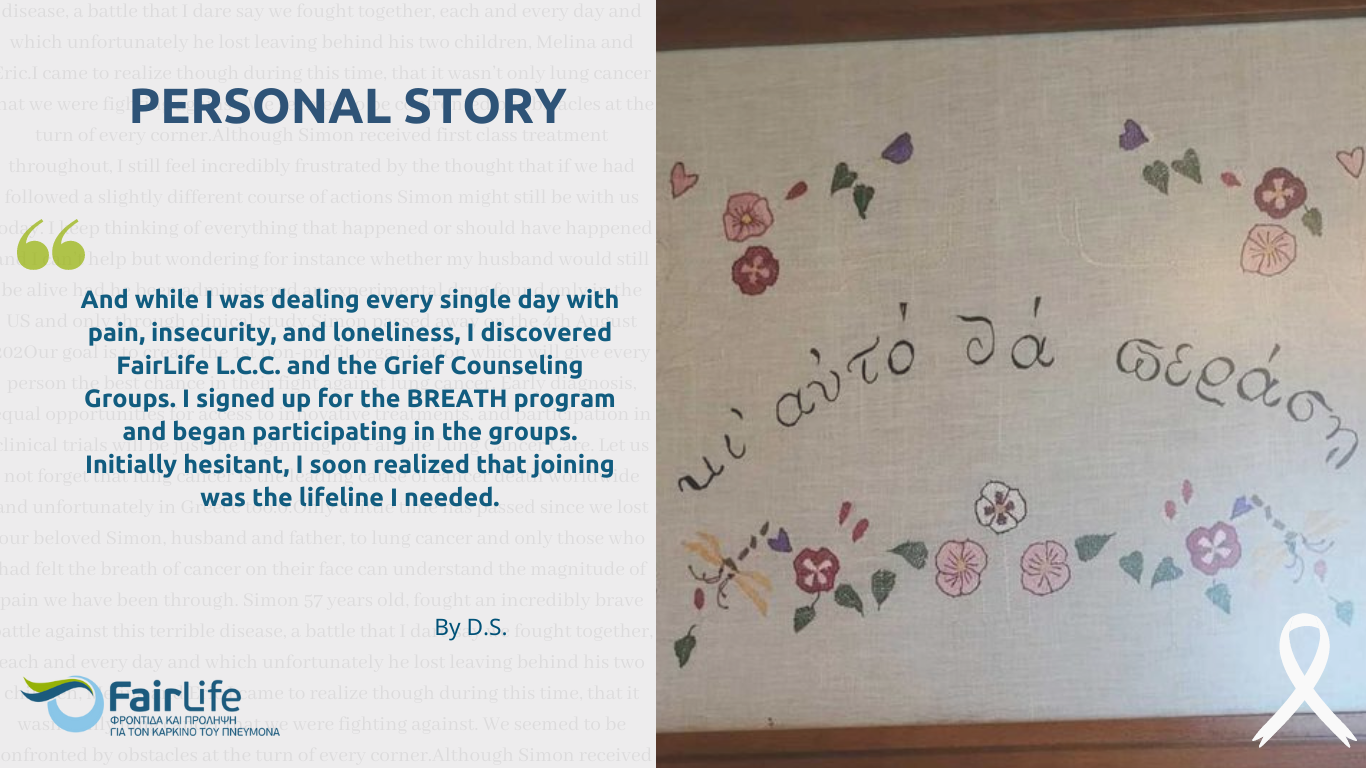
And while I was dealing every single day with pain, insecurity, and loneliness, I discovered FairLife L.C.C. and the Grief Counseling Groups. I signed up for the BREATH program and began participating in the groups. Initially hesitant, I soon realized that joining was the lifeline I needed.
I started communicating with women who, like me, are grieving and who understand and listen without judgment. Previously unknown people became my friends and support system. Sharing unspoken feelings with them lightens my soul. In the BREATH groups, a psychotherapist is always present, offering encouragement, support, and food for thought.
My husband’s absence is deeply felt, especially at night when I struggle to sleep in the silence. Sometimes I make noises just to feel alive. My daughter, who is pursuing her PhD and living independently, is very supportive but she is grieving as well and the depth of her bond with her father is now clearer than ever. I have to learn to live alone now. As I grow older and face an uncertain future, I find that those I once relied on have disappeared, while others have unexpectedly stepped up to support me. This tragic disease and loss have made me redefine my relationships and circumstances.
It’s hard to believe that a man so full of life passed away within four months. My experiences with the NHS, both as a patient and caregiver, have left me feeling insecure due to the system’s tragic conditions. Despite the presence of excellent doctors and nurses who strive to do their best, they are overwhelmed by this inhumane system, which makes the already difficult psychological state of patients and families even worse. This added insecurity is an unnecessary burden in such serious situations.
But life goes on. The river cannot flow backward. My own battle with cancer revealed my strength, and I must honor the second chance I was given. I owe it to life, to my late husband, and to my daughter. I keep repeating the optimistic phrase, “THIS TOO SHALL PASS,” which my mother embroidered about a hundred years ago under the light of an oil lamp.
7/6/2024