
Living with Cancer!
By Vassiliki Mytilinaiou, Caregiver
Andreas is my husband. He was born in July 1963. He’s a Cancer by zodiac sign, though I don’t believe in zodiac signs. In November 1985, he lost his father to lung cancer with bone metastasis, and in August 1997, his brother to the same disease.
It is now March 8, 2023 and we face a lung cancer diagnosis. Andreas doesn’t even know the smell of cigarette smoke. So let’s go back…
In October 2022, a persistent cough led him to the doctor. The doctor adjusted his blood pressure medication, which helped for a while, but the cough returned. The doctor advised a follow-up if the cough persisted, but Andreas dismissed it, thinking it would eventually go away. The cough continued to come and go.
By February 2023, Andreas started experiencing atrial fibrillation along with the cough.
In early March 2023, one afternoon on the way back from the office, Andreas’ cough became so severe that he couldn’t drive. He called the doctor and booked an appointment for that same evening. We went together, Andreas was worried, and so was the doctor. “I won’t wait four months for you to come again,” the doctor said, ordering a CT scan and blood tests.
The blood tests came back first, showing cancer markers in red. The next day, a CT scan was done. Andreas was admitted to the hospital for a bronchoscopy, which was challenging due to his anticoagulant medication. With great care, the doctor managed to take a sample. Another full-body CT scan followed.
On the morning of March 8th, at 8 am, our doctor calmly and reassuringly announced the diagnosis. “Andreas, treatments of 1985 and 1997 are nothing compared to the tools we have nowadays. So, we will move forward with optimism. We’re trying to make cancer a chronic disease.”
We didn’t ask any more questions. Leaving the hospital, Andreas began making phone calls to share the news. First, he called our children, then his brother’s children, then my siblings and then his closest friends. With each call, he seemed to grow stronger. “It’s lung cancer… we’ll face it together”.
Our family doctor, who is also a pulmonologist, connected us with his associate oncologist. Andreas immediately trusted him. I wanted Stelios, our doctor, to be involved no matter what. Andreas didn’t seek a second opinion because trust defines our relationship with each other and with our doctors.
While awaiting the molecular test results, Andreas received two rounds of chemotherapy without any side effects. When the molecular results came back, they showed he was ‘EGFR positive.’ Stelios called, excited about the targeted treatment option: one pill a day. It was the best-case scenario, though there was a 10% chance the treatment might not work.
Two months passed, and the cough persisted. Tests revealed that Andreas’ body was not responding to the treatment. We then shifted to weekly chemotherapy combined with immunotherapy. The doctors emphasized that 40% of the treatment’s effectiveness depended on positive attitude.
Meanwhile, Andreas’ condition worsened. His hair fell out, his body weakened, and his spirit dropped. He experienced pain in his calves and joints, low-grade fevers, and drops in blood pressure. He underwent two punctures and eventually pleurodesis. Week by week, his condition deteriorated.
The treatments are carried out in a private hospital, as we have had private insurance since our youth. The hospital staff is polite, helpful, and always by our side. Our doctors are present for every treatment session, and bureaucratic procedures are greatly simplified. We have authorized the hospital to bring the EOPPY medications, making the process smoother.
Treatments take place in a room where Andreas lies down, and I am always with him. Each session lasts between 5 to 8 hours, and having this level of comfort is crucial. The conditions are favorable.
Andreas is a “solid” man—a mathematician, methodical and in control. Cancer unsettles him because he cannot predict its course. The inability to plan drives him crazy. He is constantly searching for a light at the end of the tunnel.
I beg him to get help, to see a specialist, to talk, but he doesn’t want to. I stop insisting. I stay by his side, listening and feeling his anguish. He’s scared, struggling with sleeplessness, and not eating properly (he never did). He gets angry and speaks sharply, but I understand. I’m with him. Everyone chooses how to face their disease and life’s challenges.
I’ve put everything else on hold—I only go to work, and often I stay home and work remotely. He always wants me by his side, to touch him, to talk to him constantly. I’m his best therapist.
However, I’m starting to lose energy and need support myself. I complain to the doctors, “If 40% of the treatment relies on good psychology, why isn’t it a prerequisite alongside chemotherapy, immunotherapy, and other treatments?”
I have always preferred alternative and holistic approaches, including yoga, color therapy, homeopathy, reiki, theta healing, and flower remedies. I remain steadfast in my optimism and positivity. We will confront cancer, and I don’t see it as an invader. I believe the bio-psychosocial aspects of an individual play a significant role. I do believe much of the treatment depends on patients. Just as cancer appeared, it can also be reversed—however simplistic that may seem. While I have full confidence in science, I feel it lacks a holistic approach. At times, I get frustrated with both my husband and myself, but I’ve never questioned “why us?” This is our challenge, just as it is for many others.
After two months, the tests showed that the condition was stable, and treatments continued with the same intensity, as did the side effects. Genetic tests were negative, which was a positive outcome. By September, the tests were encouraging, and treatments were reduced to every two weeks. A second molecular test with a new sample revealed ALK positive , another positive development and a new tool to work with. Tests in February 2024 were even more promising, and treatments were conducted every three weeks. His body began to recover, and we tentatively resumed normal activities—enjoying coffee with friends, family meals, and walks on the beach. By Easter, we celebrated with family and friends.
In early July 2024, while treatments continue, we have another round of tests… and the light at the end of the tunnel grows brighter.
During this journey, Fair Life has become a significant part of my life. Since October 2023, I have participated in three psychosocial support groups. I find them immensely helpful, as they connect me with other people facing similar challenges, anxieties, questions, and emotions. We share experiences, learn, and support each other.
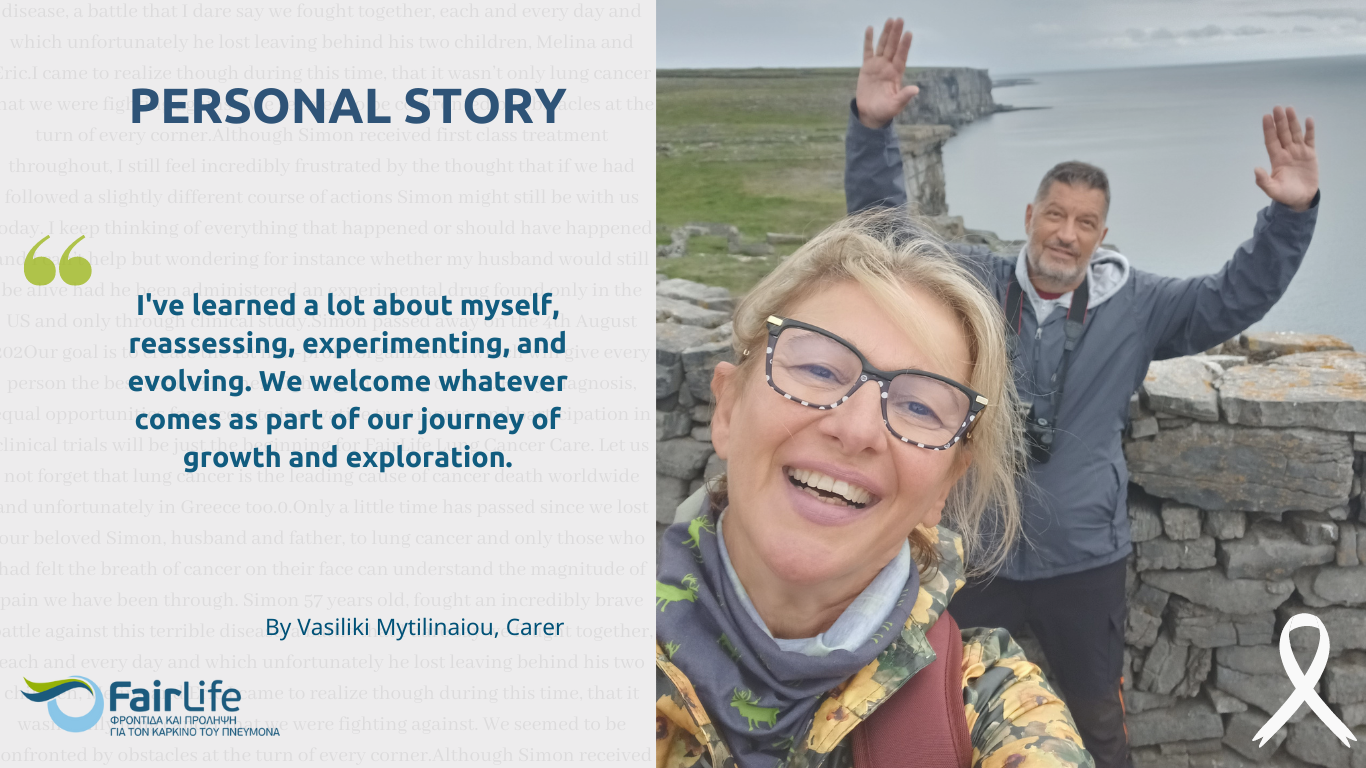
The group helps me manage my guilt, anger, and feelings, and find strength and gratitude amidst it all. Through this process, I’ve learned a lot about myself, reassessing, experimenting, and evolving. We welcome whatever comes as part of our journey of growth and exploration.
We have the support of Fair Life and our loved ones. The contributions of family, friends, and my workplace are invaluable. We have never felt alone.
Initially, the lack of information and support when dealing with side effects at home was a challenge. We had to look for information, while it would have been helpful to receive guidance along with the diagnosis.
We are on the right path and will continue moving forward…
30.06.2024