





To learn how lung cancer develops, it is useful to first understand how the lungs work. Read about how the lungs work and how lung cancer can develop.
The primary function of our two lungs is to carry oxygen to the body and remove carbon dioxide, which is formed as a waste product of the body’s cells. Each lung has sections called lobes-two in the left lung and three in the right lung. When we breathe in, air enters through our nose or mouth and passes into our windpipe (trachea). The trachea branches into two airways called the main bronchi, each of which carries air to one lung. Inside the lung, air is guided through smaller and smaller branching tubes called bronchioles until it finally enters the alveoli – very small elastic balloon-like air sacs. It is within these alveoli where oxygen is transferred into the bloodstream while carbon dioxide is removed from the bloodstream (and subsequently from the airways).
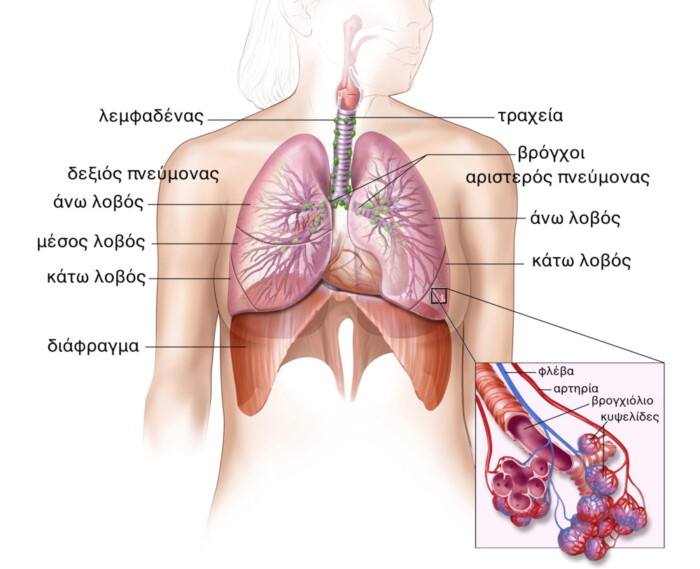
Source: https://www.drgeorgakopoulos.gr/gr/el/content/karkinos-pneymona-diagnosi-kai-therapeia
The lungs are made up of many different types of cells. Most of these cells are epithelial cells. These line the airways and produce mucus to lubricate and protect the lungs. Other lung cells include blood cells, nerve cells, hormone-producing cells and structural cells.
On the outside of each lung and lining the inner wall of the chest cavity is a thin membrane called the pleura. The pleurae form a sac called the pleural cavity, a thin layer of tissue which covers the lung and lines the inner wall of the chest cavity. Inside the pleural cavity there is a small amount of serous fluid that acts as a lubricant to allow the lungs to move freely in the chest when we breathe.
Development of lung cancer
Cells within the lungs and elsewhere in the body undergo a specific cycle of growth and death, which keeps the cell numbers under control. Cancer emerges when a distinct set of changes, called mutations, develops in previously healthy cells. When the set of mutations affects the genes so that the natural cycle of cell growth and death is altered, then uncontrolled cell division can lead to an excessive number of cells. Imagine a car with bad brakes – the cells just keep dividing non-stop.
The multiplication of mutated cells forms a mass known as a tumor, neoplasm, or lesion. A tumor can be classified as benign or malignant based on its ability to invade normal tissues, spread locally or distally and eventually cause death. In lung cancer, this growth may be detected as a nodule on a chest X-ray or CT scan. If cancerous cells invade healthy tissues, the tumor is considered malignant. Lung cancer specifically refers to tumors originating from malignant cells within the lung tissue.
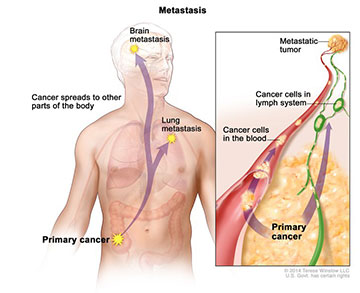
Source: https://www.endounit.gr/metastatic-cancer/
How cancer spreads
The progression of cancer from one part of the body to another is known as metastasis, and tumors that form from spreading cancer cells are called metastases. Lung cancer metastases can spread to lymph nodes around the lungs and can also travel through the bloodstream to other organs such as the bones, adrenal glands and brain. In some cases, cancer will start in other parts of the body and spread to the lung. This is considered metastasis of the original type of cancer and is called metastatic or secondary lung cancer. Only cancer that originates in the lung itself is considered as a primary lung cancer.
Source: LUNGEVITY https://www.lungevity.org/screening-for-lung-cancer/learn-about-your-risk/how-lung-cancer-develops
